
 barublog
What if the biggest lesson in scaling education came not from a tech company, but from a rural school?
In the villages of North India, where access to quality education has historically been a challenge, a remarkable educational movement began with a simple belief: where a child is born should never determine how far they can go.
That belief became the foundation of the Akal Academies.
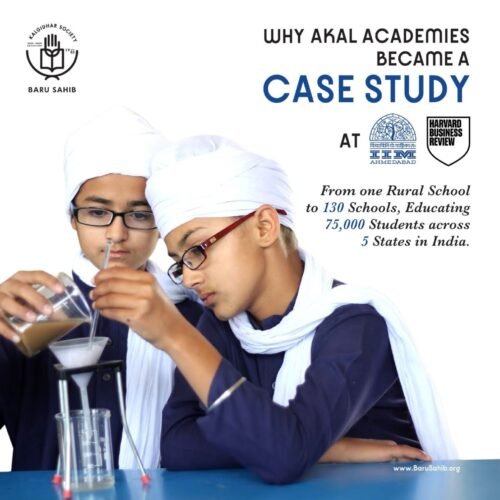
What started as a single school has grown into a network of 130 Akal Academies educating more than 75,000 students across Punjab, Haryana, Himachal Pradesh, Rajasthan and Uttar Pradesh. Today, the model has become more than an education success story—it has been examined as a case in management education at the Indian Institute of Management Ahmedabad (IIMA) and listed in the Harvard Business Review Case Collection.
The question at the heart of the journey is one that every mission-driven organisation eventually faces:
How do you scale your impact without losing your purpose?
From a Rural Classroom to a Movement
The story of Akal Academies is closely connected to the vision of Sant Baba Iqbal Singh Ji, who dedicated his life to expanding educational opportunities for rural communities.
The journey began at Baru Sahib in Himachal Pradesh with just a handful of students. The objective was never simply to build another school. It was to create access to quality, value-based education for children who might otherwise have limited educational opportunities.
Over the years, that vision expanded into a network of schools serving rural communities across five northern Indian states. The Kalgidhar Society currently describes its network as comprising 130+ rural schools and serving more than 75,000 students.
This growth demonstrates an important principle of social impact:
Scale becomes meaningful when it expands access without abandoning the mission that created the impact in the first place.
Why Akal Academies Became an IIM Ahmedabad Case Study
The growth of Akal Academies attracted academic attention because it presented a distinctive challenge in social enterprise and education management.
The case study, “The Akal Academies,” was authored by Dr. Amarpreet Singh Ghura and Prof. Vijaya Sherry Chand and published by IIM Ahmedabad’s Ravi J. Matthai Centre for Educational Innovation. IIMA lists the case as reference RJMC0043, published in March 2017.
The case examined the strategic questions surrounding the expansion of a rural school network—including how an organisation can evaluate growth opportunities, manage resources and expand its educational mission.
In 2018, the case received the Philip Thomas Memorial Case Award at IIM Ahmedabad. It was also listed in the Harvard Business Review Case Collection, giving the rural education model international academic visibility.
That recognition is significant because it shifts the conversation around rural education.
A rural school network was no longer being viewed only through the lens of charity or philanthropy.
It was being examined as a model of innovation, strategy, entrepreneurship and social impact.
The Real Challenge – Scaling Without Losing the Mission
Growing from one school to a large educational network is not simply a matter of opening more buildings.
It requires teachers, leadership, infrastructure, financial sustainability, community participation and a consistent educational philosophy.
The Akal Academies case highlights this fundamental management challenge: how can a social organisation grow rapidly while remaining aligned with its founding purpose?
For The Kalgidhar Society, the answer has been rooted in a combination of:
1. Quality Education for Rural Communities
Akal Academies were established to bring quality education closer to children in rural and underserved communities. Today, the network spans five northern states and serves more than 75,000 students.
2. Value-Based Learning
The educational approach extends beyond academic performance. The schools emphasise character development, discipline, leadership, ethics and community service alongside academics.
3. Sustainable Social Impact
The objective is not simply to increase enrolment numbers. It is to create opportunities that can influence families and communities over generations.
4. Continuous Innovation
The education model continues to evolve. Recent initiatives across the network include future-skills education involving areas such as AI, robotics, coding, STEM, entrepreneurship and design thinking, showing how rural education can respond to changing workforce requirements.
Rural Education in Punjab – Why This Model Matters
Punjab’s rural communities have enormous potential, but access to educational opportunities can vary significantly depending on geography and economic circumstances.
This is where institutions such as Akal Academies can play an important role.
By bringing structured, quality schooling into rural areas, the model addresses a fundamental inequality: the difference between the opportunities available to a child in a village and those available to a child in a major city.
The goal is not to make rural children leave their communities to find opportunity.
It is to bring opportunity closer to them.
Across Punjab and neighbouring states, this approach creates an educational ecosystem where students can develop academically while also building leadership, confidence and social responsibility.
More Than 75,000 Students – The Numbers Behind the Mission
Numbers tell only part of the story.
130+ schools.
75,000+ students.
Five northern states.
But behind every statistic is an individual student, a family and a community.
The Kalgidhar Society reports that its educational network includes students from rural and economically disadvantaged backgrounds, with thousands receiving free or subsidised education through sponsorship and support programmes.
That makes the impact of the Akal Academies model larger than school infrastructure alone.
When a child receives quality education, the benefits can extend to the family.
When families gain new opportunities, communities can change.
And when communities change, the impact can continue across generations.
What Businesses and Social Organisations Can Learn from Akal Academies
The Akal Academies case offers lessons that extend beyond education.
- Purpose Can Drive Sustainable Growth
- Growth becomes stronger when it is connected to a clearly defined mission.
- Rural Markets Are Not Defined by Rural Limitations
- Rural communities are not simply beneficiaries. They are communities with talent, ambition and enormous potential.
- Innovation Is Not Limited to Technology
Innovation can mean creating a new way to deliver education, finance expansion, engage communities or develop future-ready students.
Social Impact and Strategy Can Work Together
The Akal Academies case demonstrates that social impact organisations can also be studied through the lenses of strategy, entrepreneurship, innovation and organisational growth.
That is perhaps one of the most important lessons from the journey.
From Punjab’s Villages to Global Classrooms
The story of Akal Academies has travelled far beyond the villages where the movement began.
Its inclusion in the Harvard Business Review Case Collection and recognition at IIM Ahmedabad demonstrate that rural education can generate ideas worthy of global academic discussion.
But the most important classroom may not be a business school.
It may be the rural classroom where a child discovers a new possibility for their future.
Because ultimately, the success of rural education cannot be measured only by the number of schools built.
It must also be measured by the opportunities created.
The Legacy Continues
From one rural school to a network of more than 130 academies, the journey of Akal Academies represents what can happen when vision is combined with persistence, education with values, and growth with purpose.
The Kalgidhar Society’s rural education mission continues to evolve, with schools embracing modern learning approaches while maintaining their emphasis on character, discipline and social responsibility.
The story therefore isn’t simply about how one school became 130.
It is about how an idea travelled from one classroom to thousands of classrooms—and from one generation to the next.
And perhaps that is the real lesson.
The most powerful form of scaling is not building bigger institutions. It is creating opportunities that become bigger than the institution itself.
Be Part of the Future of Rural Education
Every child deserves an opportunity to learn, grow and build a better future—regardless of whether they are born in a city or a village.
The journey of Akal Academies shows what becomes possible when education reaches communities that need it most.
Support rural education. Sponsor a child’s education. Share this story. Help take the next step toward making quality education accessible to every child.
The future of rural India is being built in its classrooms—and every one of us can be part of that future.
Frequently Asked Questions
How many Akal Academies are there?
The Kalgidhar Society currently operates 130+ Akal Academies across rural areas of northern India.
How many students study in Akal Academies?
More than 75,000 students are currently part of the Akal Academies network.
Which states have Akal Academies?
The network spans Punjab, Haryana, Himachal Pradesh, Rajasthan and Uttar Pradesh.
Why was Akal Academies studied by IIM Ahmedabad?
The Akal Academies case examined the organisation’s approach to scaling a rural education initiative, including strategic challenges around growth, innovation and social impact. IIMA lists The Akal Academies as case RJMC0043.
Is the Akal Academies case listed by Harvard Business Review?
Yes. The case study was listed in the Harvard Business Review Case Collection and also received the Philip Thomas Memorial Case Award at IIM Ahmedabad in 2018.







Add comment