
 barublog
What If a School’s Electricity Bill Could Become a Scholarship?
What if the money a school spends on electricity could instead help create better classrooms, stronger learning resources and greater opportunities for children? This simple question lies at the heart of Solar CSR for Schools in India, an approach that connects renewable energy with long-term educational impact. For The Kalgidhar Society, solar energy is not simply about reducing electricity costs—it is about creating a more sustainable education system where every resource saved can contribute to the future of rural children.
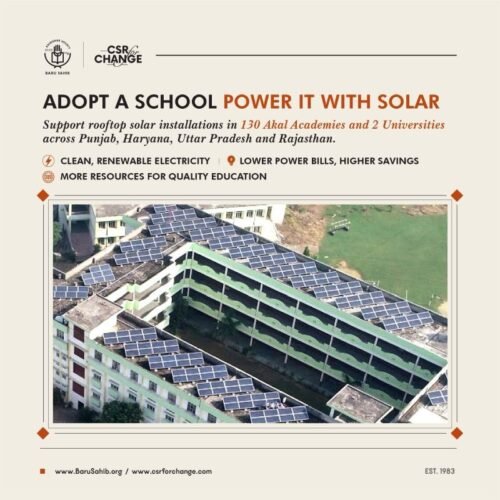
Across its education network, The Kalgidhar Society has already installed 4.4 MW of rooftop solar capacity, marking a significant step towards cleaner and more sustainable educational infrastructure. The initiative helps reduce energy costs while supporting the organisation’s larger mission of providing quality education to children in rural and underserved communities. Now, the Society is working to expand this solar mission across 130 Akal Academy Group of Schools and 2 Universities, creating an opportunity to bring renewable energy and education together at a much larger scale.
Solar CSR for Schools in India – Where Sustainability Meets Education
Electricity is an essential part of every modern school. Classrooms, computer laboratories, libraries and other learning facilities all depend on reliable power. At the same time, rising operational costs can place pressure on educational institutions and limit the resources available for other priorities. Rooftop solar provides an opportunity to change this equation by allowing schools to generate clean energy while potentially reducing their dependence on conventional electricity.
For The Kalgidhar Society, the purpose goes beyond installing solar panels. The real objective is to create a sustainable model in which energy savings can support the broader educational mission. When fewer resources are required for electricity, more attention and resources can be directed towards classrooms, teachers, learning materials, technology and other areas that directly benefit students. In this way, solar energy for schools becomes more than an environmental initiative—it becomes an investment in education.
4.4 MW of Solar Power With a Bigger Purpose
The Society’s existing 4.4 MW rooftop solar capacity demonstrates that renewable energy can be integrated into a large educational network. The next phase is to scale this approach across 130 Akal Academy Group of Schools and 2 Universities, creating a wider network of institutions powered by a cleaner and more sustainable energy model.
This expansion represents a significant opportunity for CSR solar energy projects in India. Instead of viewing renewable energy and social development as separate priorities, organisations can support an initiative where both objectives work together. Solar infrastructure can contribute to environmental sustainability while the resulting financial efficiencies can strengthen the long-term educational ecosystem.
Why Solar Energy Matters for Rural Education
For children in rural communities, access to quality education depends on much more than the presence of a school building. Educational institutions need reliable infrastructure, trained teachers, technology, learning resources and sustainable operating systems to provide students with meaningful learning opportunities. Renewable energy can become an important part of that infrastructure.
By adopting solar power, schools can take a practical step towards cleaner energy while creating the potential for long-term operational savings. These savings can contribute to educational priorities and help institutions build greater resilience. At the same time, sustainable school campuses can help students understand the importance of renewable energy, environmental responsibility and climate action.
This makes solar CSR for rural education particularly meaningful. A single CSR investment can simultaneously address environmental sustainability and social development, creating an impact that extends beyond the immediate installation.
The Real Equation – Less Energy Cost, More Educational Opportunity
The idea behind this initiative can be expressed simply: less spent on electricity can mean more resources available for education. While the exact financial savings will vary from institution to institution, the underlying principle remains powerful. When schools become more energy-efficient and generate a greater share of their own clean energy, resources can potentially be redirected towards areas that have a direct impact on students.
This could mean stronger classrooms, better learning resources, improved technology infrastructure and continued investment in teachers and educational programmes. At the same time, the transition to solar energy contributes to India’s wider movement towards renewable energy and sustainable development.
For CSR partners, this creates an opportunity to support a project with both environmental and social dimensions. It connects CSR, ESG, renewable energy, education and climate action through one scalable initiative.
A CSR Partnership Opportunity for Sustainable Schools
Scaling this mission across 130 schools and 2 universities requires collaboration. Through CSRforChange.com, The Kalgidhar Society is inviting CSR partners, foundations, philanthropists and individual donors to support the expansion of its solar initiative.
The opportunity is not simply to fund solar infrastructure. It is to contribute to a model where every rooftop can become part of a larger educational and sustainability mission. One school powered by solar energy may appear to be a small step, but when the model is replicated across a large network, the cumulative impact can become significant.
For organisations looking for CSR projects in India that combine education and sustainability, supporting solarisation of schools offers a practical pathway to create measurable and long-term impact. It brings together environmental responsibility and social development while supporting educational institutions that serve children and communities.
Building a Sustainable Future Through Education
The Kalgidhar Society’s solar mission reflects a broader belief that sustainability should be built into the institutions that shape future generations. Schools are not only places where children learn academic subjects; they are also spaces where values, awareness and responsible citizenship are developed.
By introducing renewable energy into educational institutions, schools can become examples of sustainable infrastructure while continuing their core mission of educating children. The vision is to create an education ecosystem where clean energy supports learning, responsible resource use supports institutional sustainability, and the benefits of these efforts ultimately reach students and communities.
With 4.4 MW already installed and plans to scale solar power across 130 Akal Academy Group of Schools and 2 Universities, The Kalgidhar Society is taking a long-term approach to sustainable education.
How Can Organisations Support Solar CSR for Schools?
Companies, foundations, philanthropists and individual donors interested in supporting this mission can explore partnership opportunities through CSRforChange.com. The Kalgidhar Society is CSR-1 registered and eligible to receive contributions under Section 135 of the Companies Act, 2013, as stated in the organisation’s initiative.
If your organisation is looking for a CSR initiative where education, renewable energy, sustainability and social impact come together, this solar mission offers an opportunity to contribute to infrastructure designed for long-term value.
Call at: +91-7341170707
Visit: CSRforChange.com to explore the initiative and discuss a partnership.
Power a School Today. Empower Generations Tomorrow.
A solar panel may begin on a school rooftop, but its potential impact can reach far beyond the building. It can contribute to cleaner energy, more sustainable institutions and resources that support education for years to come.
The Kalgidhar Society’s vision is simple: turn energy savings into educational opportunity and power schools today to empower generations tomorrow.
Support Solar CSR for Schools in India and become part of a movement where sustainability helps create a stronger future for rural education.
Frequently Asked Questions
1. What is Solar CSR for Schools in India?
Solar CSR for Schools in India uses corporate social responsibility funding to support rooftop solar and sustainable energy solutions for educational institutions.
2. How is The Kalgidhar Society using solar energy?
The Kalgidhar Society has installed 4.4 MW of rooftop solar capacity and plans to expand solar power across 130 schools and 2 universities.
3. How does solar energy benefit rural schools?
Solar energy can reduce electricity costs, support cleaner energy use and help schools redirect resources towards classrooms, teachers and learning facilities.
4. How can CSR support solar energy projects in schools?
CSR partners can fund solar infrastructure and help educational institutions adopt renewable energy while creating long-term environmental and social impact.
5. How can organisations support The Kalgidhar Society’s solar initiative?
CSR partners, foundations and donors can support the expansion through CSRforChange.com and help power sustainable schools for future generations.







Add comment