
 barublog
One CSR cheque. Fifteen students. Fifteen futures rewritten.
That’s not a tagline — it’s what happens when CSR stops writing one-off cheques and starts building pathways instead. Somewhere between a spreadsheet and a scholarship, an idea has been quietly proving itself: education, fully funded, can do more for a community than almost any other form of corporate giving. No ribbon-cutting, no press conference — just students walking onto campuses who otherwise never would have. This is that story.
CSR Education in the Sikligar Community – How Access Is Being Created
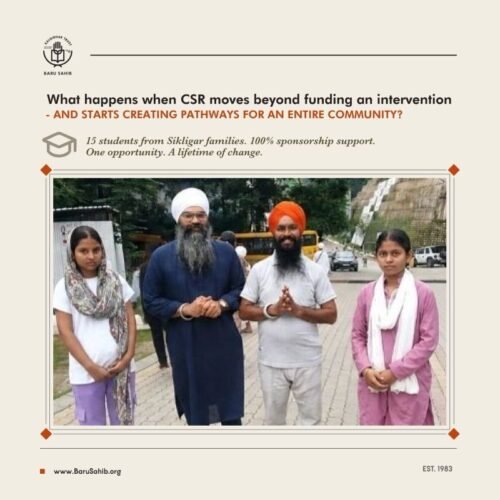
Through Educate To Save, an initiative of The Kalgidhar Society, nearly 15 students from Sikligar families have received 100% sponsorship support over the past two years to study at Eternal University in Baru Sahib, Sirmour, and Akal University in Talwandi Sabo.
Not partial scholarships. Not “up to” a certain amount. Full sponsorship — the kind that removes tuition fees from the equation entirely and replaces “can we afford this?” with “let’s begin.”
That distinction matters more than it sounds. For many capable students, the barrier to higher education was never ambition or ability. It was cost. Close that gap completely, and something shifts — not just for the student sitting in the classroom, but for everyone watching from home.
Who Are the Sikligar Community — and Why Does This Matter So Much?
The Sikligar community holds a distinctive place in Sikh history, traditionally known for metalworking and craftsmanship passed down through generations — skills that once anchored entire livelihoods. But traditional trades don’t always keep pace with a changing economy, and that’s where the story gets interesting.
As livelihoods evolve, education becomes the new toolkit. A degree can do for the next generation what a hammer and forge did for the last — open doors, build skills, and create room to grow. This isn’t about replacing heritage. It’s about adding options to it.
That’s the real opportunity CSR can step into here: not erasing a community’s identity, but expanding what’s possible for the young people carrying it forward.
CSR That Pays vs. CSR That Transforms
Here’s the uncomfortable truth about most CSR spend on education: a lot of it stops at the receipt. Fees get paid, a report gets filed, a photo gets taken — and the story ends there.
Strategic CSR education doesn’t stop at the receipt. It follows the student.
When someone who might otherwise never have set foot on a university campus gets that chance, the ripple effects show up everywhere:
- New skills, new careers, new possibilities
- Real financial independence — not “one day,” but eventually, tangibly
- Confidence that didn’t exist before, and ambition that grows with it
- A financial floor under an entire family, not just one person
- A visible, living example for every younger sibling, cousin, and neighbour watching
That last point is easy to underestimate. One student succeeding doesn’t just change their own trajectory — it resets what an entire community believes is possible for the ones coming next.
This is exactly why Educate To Save treats education sponsorship as an investment in human potential, not a donation line item to tick off a CSR checklist.
The Engine Behind It – The Kalgidhar Society and Educate To Save
None of this happens by accident. The Kalgidhar Society, through Educate To Save, exists specifically to close the gap between students who have the drive to pursue higher education and the financial walls that would otherwise stop them cold.
By partnering directly with institutions like Eternal University and Akal University, the initiative creates a clean, traceable line from CSR rupee to enrolled student — no guesswork, no vague “impact,” just a funded seat and a name in a classroom. For corporates who want to know exactly where their CSR budget lands, that traceability is worth more than most glossy impact reports.
Stop Asking “How Many?” Start Asking “How Far?”
Most CSR education strategy gets stuck on one question: how many students can we fund this year? It’s a fair question. It’s also the smaller one.
The sharper question is this: how many young people can we help become genuinely capable, independent, and economically empowered — for the rest of their lives?
Answer that question at the community level instead of the individual level, and something changes. CSR stops being an annual expense and starts becoming a compounding return — one that keeps paying out long after the fiscal year closes, long after the report is filed, sometimes for generations.
Impact Snapshot
Students supported – Nearly 15
Sponsorship coverage – 100%
Time period – Past two years
Community – Sikligar families
Partner universities – Eternal University (Baru Sahib), Akal University (Talwandi Sabo)
Implementing body – The Kalgidhar Society, via Educate To Save
CSR focus areas – Education, youth empowerment, rural development
What CSR Partners Actually Get Back
Let’s be honest — CSR budgets don’t get approved on good intentions alone. They get approved when someone can point to a number, a name, an institution, and say: here’s exactly where this went, and here’s what it did.
That’s the quiet advantage of a programme like this. There’s no ambiguity about impact. A rupee spent through Educate To Save doesn’t disappear into an overhead line — it becomes a seat in a classroom, a name on an enrolment list, a student who can be tracked from admission to graduation. For a CSR head who has to defend the budget to a board next quarter, that clarity is worth more than almost any other metric.
There’s also the compounding brand value that comes from backing something specific instead of something generic. “We support education” is a sentence that disappears into a hundred identical annual reports. “We funded 15 students from the Sikligar community through two named universities” is a sentence people remember — and repeat.
The Bigger Picture – Why Education-Led CSR Outperforms
Education sponsorship sits in a strange sweet spot within CSR strategy. It’s measurable enough to satisfy a finance team, human enough to satisfy a communications team, and durable enough to satisfy a sustainability team — three departments that rarely agree on anything, agreeing on this.
Compare it to a one-time infrastructure donation or an equipment grant. Those are valuable, but they’re finite — the impact is largely locked in the moment the cheque clears. A funded education, by contrast, keeps generating returns for decades: through the student’s career, through their family’s finances, through the next sibling who now believes university is possible too.
That’s the case for treating education not as a checkbox in the CSR calendar, but as one of the highest-leverage line items available — one where a fixed cost today keeps compounding value for years after the invoice is closed.
Why This Should Be on Every CSR Leader’s Radar
Fifteen students have already started this journey. That number could easily be fifty, or five hundred — the model works, the pathway exists, and the only thing standing between “nearly 15” and the next cohort is funding.
For CSR leaders under pressure to show more than a compliance tick-box, this is the kind of programme that writes its own impact report: fully funded students, named institutions, a clear before-and-after, and a story a board actually wants to hear. Education sponsorship, done this way, isn’t charity dressed up in corporate language — it’s one of the most efficient CSR investments available, rupee for rupee.
The Next 15 Students Are Waiting
Fifteen lives have already changed. The next fifteen are one partnership away.
Start a conversation at EducateToSave.com or explore more at CSRforChange.com — and help write the next chapter.
Frequently Asked Questions
1. What is Educate To Save, and who runs it?
Educate To Save is an education sponsorship initiative run by The Kalgidhar Society. It funds students from underserved communities, enabling them to access higher education at institutions including Eternal University and Akal University.
2. How many Sikligar community students have been supported so far?
Nearly 15 students from Sikligar families have received 100% sponsorship support through Educate To Save over the past two years, covering their full access to higher education.
3. Which universities are involved in this CSR education initiative?
Sponsored students study at Eternal University in Baru Sahib, Sirmour, and Akal University in Talwandi Sabo, both part of The Kalgidhar Society’s broader educational network.
4. Why is the Sikligar community a focus of this CSR programme?
The Sikligar community holds a distinctive place in Sikh history, traditionally associated with metalworking and craftsmanship. As traditional livelihoods evolve, education and employable skills open new economic pathways for the community’s younger generation.
5. How can a corporate organisation partner with Educate To Save for CSR?
Organisations interested in CSR partnerships focused on education, youth empowerment, or rural development can connect through EducateToSave.com or CSRforChange.com to explore sponsorship and collaboration opportunities with The Kalgidhar Society.




Add comment