
 barublog
India’s CSR landscape has changed significantly since Corporate Social Responsibility became a legal requirement under Section 135 of the Companies Act, 2013. Every year, thousands of companies contribute funds toward education, healthcare, rural development, environmental sustainability, women empowerment and other social causes.
But there is another side to the growing numbers.
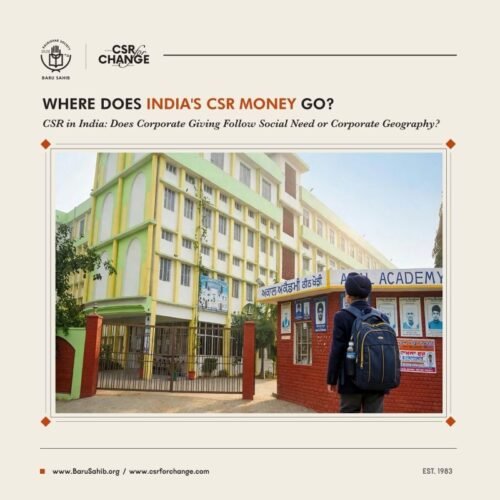
Where does India’s CSR money actually go—and who gets left behind?
The question is not simply about how much companies spend. It is about where that money is going, which communities benefit from it and whether CSR investment is reaching the places where social and developmental needs are greatest.
Recent research has highlighted a significant geographical imbalance in CSR spending in India. Studies have found that a large proportion of CSR funds tends to flow toward states that already perform relatively well on socioeconomic indicators, while economically disadvantaged regions receive comparatively less.
This raises a bigger question:
Does CSR follow social need—or does it follow corporate geography?
Read the full analysis on CSR spending in India: Read the full analysis
Understanding CSR Spending in India
Corporate Social Responsibility is intended to encourage companies to contribute toward social and environmental development. CSR projects can cover areas such as education, healthcare, sanitation, livelihood development, skill development, environmental sustainability and community infrastructure.
The opportunity is enormous.
When CSR funds are strategically invested, they can help communities gain access to resources and opportunities that may otherwise remain out of reach. A well-designed education programme, for example, can influence not just a student’s immediate learning but also their future employment and economic opportunities.
However, the distribution of CSR funds in India matters just as much as the overall amount being spent.
The Ministry of Corporate Affairs’ National CSR Exchange Portal provides state- and district-level information on CSR expenditure. Importantly, the portal itself acknowledges that CSR has historically been supply-driven and that a geographical skew has favoured industrialised states, while less-developed states have received comparatively less funding.
This makes geographical distribution an important part of the CSR conversation.
Does CSR Follow Social Need or Corporate Geography?
One reason CSR funding can become geographically concentrated is simple: companies tend to have stronger relationships with the areas where they operate.
A company may have its headquarters, manufacturing facilities, employees or major business operations in a particular state. Supporting communities around those operations can be practical and meaningful.
But when many companies follow the same pattern, CSR investment can become concentrated in areas that already have a stronger corporate ecosystem.
Research published in Development in Practice found that a significant share of CSR spending has gone to states that were already performing relatively well on socioeconomic indicators, while underdeveloped and economically disadvantaged states received comparatively limited CSR expenditure.
The issue, therefore, is not that corporate investment in developed states is inherently wrong.
The bigger question is whether corporate presence should be the strongest factor determining where CSR money goes.
If it is, communities with fewer companies operating nearby may have fewer opportunities to attract CSR funding—even when their need for education, healthcare, employment opportunities and infrastructure is substantial.
Why CSR Spending by State Matters
Looking only at India’s total CSR expenditure can hide important regional differences.
The Ministry of Corporate Affairs’ Corporate Data Management Portal provides comprehensive CSR data by financial year, sector and state, allowing stakeholders to examine how CSR spending is distributed across the country.
This state-wise perspective is important because the same amount of funding can have very different implications depending on the population, economic conditions and development needs of a region.
For this reason, CSR spending by state and CSR spending per capita can provide a more meaningful picture than national totals alone.
The question should not simply be:
How much CSR money was spent?
It should also be:
Where was it spent? Who benefited? What problem did it address? And what changed because of it?
These questions move the conversation from CSR expenditure to CSR impact.
The Rural India CSR Gap
Rural communities often face challenges that require sustained investment.
Access to quality education, healthcare, digital resources, skill development, employment opportunities and essential infrastructure can vary significantly between urban and rural areas.
For a child in an underserved rural community, access to a quality school can influence their entire educational journey. For a young person, vocational training can open a path toward employment. For women, education and skills can create opportunities for greater economic participation.
This is why CSR and rural development should be viewed as closely connected.
CSR funding can help address some of these challenges when it is directed toward well-planned programmes and implemented by organisations that understand the communities they serve.
The goal should not simply be to complete a project.
The goal should be to create opportunities that continue to benefit communities long after the initial CSR funding has been spent.
From CSR Spending to CSR Impact
A successful CSR programme should be measured by more than the amount of money invested.
It should also be measured by what that investment achieves.
For an education programme, this could mean looking beyond the number of students enrolled and considering attendance, retention, academic progress, access to higher education and future opportunities.
For healthcare programmes, the impact may involve improved access to healthcare services and better health outcomes within the communities being served.
For livelihood programmes, success can be reflected in skills gained, employment opportunities and increased economic participation.
This shift from activity-based CSR to outcome-based CSR is important because it changes the focus from what was done to what changed.
The Kalgidhar Society – Taking CSR Beyond Corporate Geography
The Kalgidhar Society is an example of a grassroots organisation working to connect CSR partnerships with communities in rural and underserved regions.
Through its CSR for CHANGE initiative, the organisation works across areas including rural education, healthcare, women empowerment, environmental sustainability, infrastructure and disaster relief.
Education is one of its major areas of work. Through its network of rural schools and higher education institutions, The Kalgidhar Society focuses on expanding educational opportunities for children and young people in communities where access to quality education can be challenging.
CSR partnerships can support initiatives such as scholarships, educational infrastructure, computer facilities and other resources that can strengthen learning opportunities for rural students.
The organisation also works in areas such as women’s empowerment, healthcare and rural development, reflecting a broader approach to creating sustainable community impact.
This is where the role of an experienced implementing organisation becomes important. Companies can provide financial resources and expertise, while grassroots organisations can bring local knowledge, established community relationships and experience in implementing projects on the ground.
Together, these partnerships can help take CSR beyond corporate geography and closer to social need.
Explore The Kalgidhar Society’s CSR initiatives: CSR for CHANGE – The Kalgidhar Society
Transparency Matters in CSR
As CSR spending grows, transparency becomes increasingly important.
Companies and implementing organisations should be able to explain how CSR funds are being used, who the beneficiaries are and what outcomes the projects are producing.
For companies, responsible CSR decision-making involves looking beyond a project’s title or the number of beneficiaries. It means understanding the implementing organisation, the programme design, the intended outcomes and how progress will be monitored.
For implementing organisations, transparency means clearly communicating their programmes, impact and use of resources.
The National CSR Exchange Portal itself is designed to connect corporates and implementing agencies and provides tools for identifying CSR projects, implementing agencies and state- and sector-wise CSR information.
Greater transparency can help companies make better decisions and can strengthen trust between businesses, nonprofits and the communities they aim to support.
Punjab and the CSR Distribution Question
Punjab is particularly relevant to this discussion.
The broader data on CSR distribution shows why it is important to examine not just how much CSR funding is available nationally, but also how it reaches individual states and communities.
Within a state, there can also be considerable differences between urban centres and rural areas. A state may have a significant corporate presence while some rural communities continue to face gaps in education, healthcare, skills and employment opportunities.
This makes Punjab an important part of the conversation about how CSR spending in India can become more inclusive.
The question is not simply whether CSR money reaches a state.
It is whether that investment reaches the communities where it can create meaningful additional impact.
How Companies Can Make CSR More Impactful
A more effective CSR strategy does not necessarily mean moving all corporate funding away from areas where companies operate.
Local communities around business operations will continue to be important stakeholders, and companies have valid reasons to support them.
However, companies can also look beyond their immediate corporate geography.
Data can help identify communities and regions where gaps in education, healthcare, livelihoods or infrastructure remain significant. Partnerships with credible grassroots organisations can then help companies design and implement programmes in those areas.
This can create a more strategic approach to CSR funding allocation.
Instead of asking only:
“Where can we spend our CSR budget?”
companies can ask:
“Where can our CSR investment create the greatest social impact?”
That shift can transform CSR from an annual expenditure into a long-term investment in communities.
What Should the Future of CSR Spending in India Look Like?
India’s CSR framework has created a powerful opportunity for the corporate sector to contribute to social development.
The next challenge is ensuring that this opportunity is used strategically.
The future of CSR spending in India should not be measured only by increasing expenditure. It should also be measured by how effectively funds reach underserved communities, how transparently they are used and what measurable outcomes they create.
The latest government CSR data continues to provide state-wise and sector-wise information, making it possible for stakeholders to examine the geographical distribution of CSR spending more closely.
A stronger CSR ecosystem can bring together corporate resources, grassroots expertise and community needs.
Companies can bring funding and scale. Implementing organisations can bring local knowledge and execution capabilities. Communities can help identify the challenges that matter most to them.
When these three elements work together, CSR has the potential to create impact that goes far beyond a single project.
CSR Should Follow Social Need
India does not simply need more CSR spending.
It needs more strategic, transparent and impact-focused CSR spending.
The geographical concentration of CSR investment raises an important question about whether corporate presence has too much influence over where CSR funds flow. Government data and research make it clear that geographical distribution deserves greater attention, particularly when some less-developed regions continue to receive comparatively less CSR investment.
For organisations working on the ground, the questions are simple but powerful:
- Where did the money go?
- Why there?
- Who benefited?
- And what changed because of it?
When companies and implementing organisations consistently ask these questions, CSR becomes more than a financial obligation.
It becomes an opportunity to expand access to education, strengthen rural development, empower communities and create opportunities that can change lives for generations.
CSR should not only follow corporate presence. It should follow social need.







Add comment