
 barublog
In His Own Presence
The most enduring lessons don’t arrive as lectures. They arrive quietly — in a single unhurried sentence from someone who stopped performing wisdom long ago, and simply began living it.
Eight such moments. One man. A truth that doesn’t leave you
The Man Behind The Teachings
In childhood, listening to his mother’s anecdotes about Bhagat Dhruv, Bhagat Prahlad, and the Sahibzadas, he developed a deep inclination toward devotion to God. From a very young age, he would sit alone in his room or walk into forests and hills, absorbed in the remembrance of the Divine. After hearing from his school teacher about Emperor Ashoka’s son and daughter — who, without marrying, took a vow to spread Buddhism throughout the world — he too made a firm decision. Reflecting on the immense sacrifices made by the Gurus for humanity, he resolved that he would not marry, and would dedicate his entire life to spreading Guru Nanak Dev Ji’s message of truth across the world
In accordance with the command of Sant Teja Singh Ji, he arranged his own transfer from the agriculturally advanced state of Punjab to Himachal Pradesh — where, owing to the hilly terrain, prospects of career promotion were very limited. Many officers taunted him, asking why he was making such a foolish decision. He remained steadfast, driven by a profound zeal to fulfil Sant Ji’s command and to reveal Baru Sahib. By grace, both aims were fulfilled: Baru Sahib was revealed, and he rose to retire from the highest post in his department.

These institutions stand in the deep rural heartland of North India, imparting values-based education to marginalised children who would otherwise be exposed to the menace of drugs and alcohol — a quiet revolution, built one child at a time.
The Man Behind The Mission
One resolve. One lifetime. 75,000 lives changed.
As a child, moved by stories of Bhagat Dhruv, the Sahibzadas, and Emperor Ashoka’s selfless children, he made a decision most would never dare — no marriage, no compromise. Only a life fully given to spreading Guru Nanak Dev Ji’s truth. On Sant Teja Singh Ji’s command, he left a thriving career in Punjab for the remote hills of Himachal Pradesh. Colleagues called it foolish. He called it faith. He revealed Baru Sahib — and still retired as the department’s highest officer.
Today, his institutions stand as proof — that one person’s unshakeable resolve can rewrite the future of an entire generation.
The Teachings
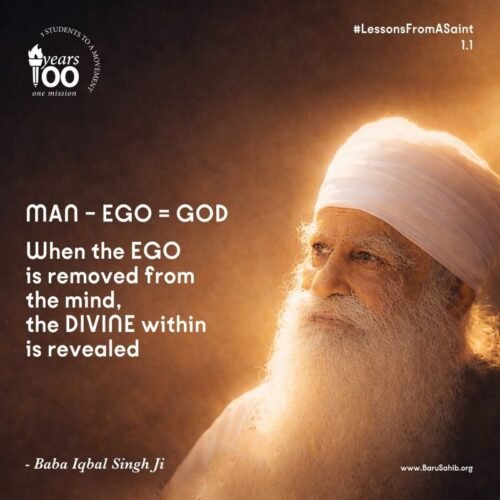
Lesson I :Man Minus Ego Equals God
“Surrounded by scattered papers, deep in thought, he sat on a simple mattress on the floor. A typist worked nearby, a
sevadar noted things down — yet the atmosphere carried a silence that spoke louder than words.”
— Rajouri Garden, Summer of 2005
Without looking up, Baba Iqbal Singh Ji said something that would stay forever: “One of the simplest yet the most difficult things in life is to become God-like.” And when asked how, he offered not a sermon but a formula.

Ego is not always loud. It shows up as the need to prove yourself right, the desire for validation, the inability to forgive, and the grip of identity. To remove it is to embrace humility, surrender, and truth — which is precisely where most of us struggle. To deepen this, he recited a verse from Gurbani:
 Read Original Post On Linkedin
Lesson II : Empty Hands, Full Truth
On a rainy journey, a question arose about happiness and wealth — about whether more possessions bring more contentment. The answer was quiet, but it cut through like light through cloud.
Baba Iqbal Singh Ji revealed that happiness does not grow as wealth increases. It grows as desires fade. The man with empty hands who wants nothing is freer than the man with full hands who wants more.
 Read Original Post On Linkedin
Lesson III: You Can’t Love What You Keep Judging
In a quiet moment at Baru Sahib, he turned to a simple but devastating observation about human relationships. We measure people. We compare them. We file them against a standard of our own making — and then wonder why love feels distant.
True love, he reminded, cannot exist where judgment lives. People are not equations to be solved or performances to be rated. They are not meant to be measured, compared, or replaced. They are meant to be understood.

Read Original Post On Linkedin
Lesson IV: Stop Watching Your Steps — Start Seeing the Mountain
In a moment of frustration over delays and small failures, Baba Iqbal Singh Ji offered a perspective that silenced the room. When we are obsessed with every stumble, every step that goes wrong, we lose sight of why we are climbing at all.
 Success is not about avoiding setbacks. It is about keeping your eyes on the summit even when the path beneath your feet is rocky. The climber who stares at the ground will miss the mountain entirely.
Read Original Post On Linkedin
Lesson V: Control the Monkey Mind Before It Controls You
In a room filled with noise and competing voices, Baba Iqbal Singh Ji brought instant silence with a single truth. The restless, scattered, ever-jumping mind — what ancient wisdom calls the “monkey mind” — is the source of most of our suffering.
We let our thoughts drag us from worry to regret to fantasy and back again, never arriving anywhere. True peace does not begin outside. It begins the moment we take hold of that restless mind and say: enough.

Read Original Post On Linkedin
Lesson VI: You Can’t Walk Two Paths at Once
In a powerful teaching on devotion, Baba Iqbal Singh Ji spoke of those who enter the path of seva and spirituality — but keep one foot still in the world they came from, one eye still glancing backward.

He was clear: true surrender means complete commitment. Half-devotion is not devotion. Those who keep looking back — clinging to identity, comfort, or approval — never truly move forward. The spiritual path demands the whole self, not the spare parts.
Read Original Post On Linkedin
Lesson VII: Don’t Just Tell Them What to Do — Teach Them Why
In a simple, unhurried moment, he revealed what separates true leadership from mere management. Instructions create followers. Understanding creates thinkers. When you teach someone only whatto do, you produce dependency. When you teach them why, you produce capability.

Real growth — in an institution, in a family, in a community — happens not by increasing the number of people following orders, but by increasing the number of people who understand the mission deeply enough to carry it forward on their own.
Read Original Post On Linkedin
Lesson VIII: You Don’t Hear Wisdom — You Tune Into It
In a quiet gathering, Baba Iqbal Singh Ji offered perhaps the most subtle of all his teachings. Words of wisdom have always existed. The Gurbani has been sung for centuries. The saints have always spoken. And yet, for most people, the words pass through without landing.
He compared the receptive mind to a radio: the signal is always broadcasting, but you must first be tuned to the right frequency to receive it. Wisdom cannot be forced into a distracted, closed,

or noisy mind. It requires inner stillness — a readiness to receive.
Read Original Post On Linkedin
Lesson IX: When “Fool” Means “Beloved”
In 2005 at Cheema Sahib, young sevadars laughed when Babaji scolded a senior sevadar as “moorkha” (fool), assuming it was a rebuke. Later, on the drive to Delhi, Babaji revealed the deeper truth: formal titles like “Maharaj” or “Sahib” signal distance, while first names and even rough words like “moorkha” or “jhalleya” are reserved for those closest to his heart. The narrator (Nirgunn) realized he’d misjudged an act of affection as humiliation — and Babaji, without ever naming his silent giggling in the room, gently corrected him anyway.

Core teaching: Closeness isn’t measured by respectful formality — it’s measured by how comfortable someone is being informal, even harsh, with you. The rougher the word from someone who loves you, the deeper the bond.
Read Original Post On Linkedin
A Life Lived as Teaching
What made Baba Iqbal Singh Ji remarkable was not just what he said, but how he lived. From a handful of students to a vast network of institutions across rural India — his mission proved that true spirituality is not separate from service. It is expressed through it.
Some lessons are written in books. Others are felt deep within. These were the second kind.
The Journey Continues
A Saint’s wisdom has no last page. These eight lessons are only the beginning. More teachings, more moments, more words that quietly change everything — are on their way. Stay close.








Add comment