
 barublog
In rural Punjab, the village daughter has long been the first child pulled out of school when money runs short. This year, she is the one topping the country.
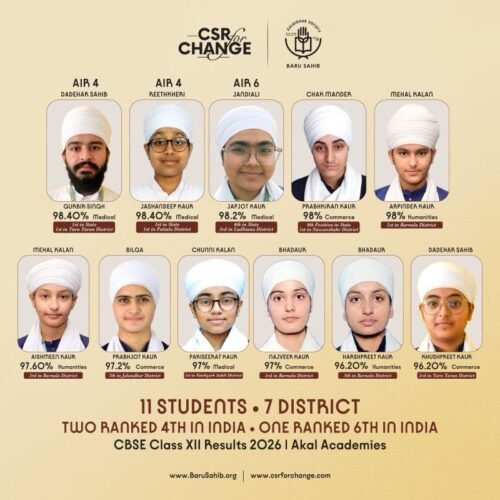
The Akal Academy CBSE 2026 results tell a story that the most expensive schools in India could not match this season. Eleven students. Seven districts. One national stage. Ten of those eleven high scorers are girls — daughters of farmers, a driver, a salesman, a water-supply worker. Families for whom quality education has always sat just out of reach.
This is what happens when a system refuses to write a child off.
Eleven Students, Seven Districts, One National Stage
Across rural Punjab, eleven students from the Akal Academy Group of Schools posted CBSE Class 12 scores that place them among the country’s highest performers in 2026. Their results span seven districts — Tarn Taran, Patiala, Ludhiana, Barnala, Fatehgarh Sahib and beyond.
What ties them together is not privilege. It is the opposite of it. These are ordinary children from ordinary homes, made extraordinary by one thing: people who chose to stand quietly behind them for a decade.
Three High Scorers Among India’s Best
Three Akal Academy students ranked among the country’s top scorers in the 2026 CBSE Class 12 examination. All three studied at Akal Academy from Kindergarten through Class XII — a full decade inside the same network of care.
Two of these three top performers are girls. A decade of someone, somewhere, quietly keeping faith with a child — and this is what that faith becomes.
A note on ranks: CBSE no longer publishes an official All India Rank or topper list for Class XII. These rankings are reported at the school and district level and reflect performance among India’s highest scorers.
Eight More Who Rose
Beyond the top three, eight more Akal Academy students delivered results their families once thought impossible.
Prabhkiran Kaur — 98%, 9th in Punjab, daughter of a farmer.
Arpinder Kaur — 98%, 1st in Barnala, daughter of a driver.
Pariseerat Kaur — 97%, 1st in Fatehgarh Sahib.
Aishmeen Kaur — 97.6%, daughter of a farmer.
Najveer Kaur — 97%, daughter of a farmer.
Prabhjot Kaur — 97.2%, daughter of a water-supply worker.
Harshpreet Kaur — 96.2%, daughter of a farmer.
Khushpreet Kaur — 96.2%, ranked 3rd in Tarn Taran.
Khushpreet’s story carries a weight the percentages cannot hold. She lost both her parents — and ranked third in her district anyway. It is a reminder that a result like this is never only about a number. It is about a child who kept going, and a school that never let go.
Why Girls Are Leading in Rural Punjab
For decades, the assumption in many villages was simple: if a family could afford to educate only one child, it would not be the daughter. The Akal Academy CBSE 2026 results quietly dismantle that assumption.
Ten of the eleven high scorers are girls. They are not topping despite being from rural farming families — they are topping from inside those families, carrying the hopes of their parents and their villages on their results.
The question is no longer whether rural girls can compete. It was answered eleven times over this season. Girl child education in India is not a charity slogan here. It is a measurable, repeatable outcome.
A Decade of Quiet Faith
The pattern beneath these results is consistency. The three highest scorers were not parachuted in for the final two years of coaching. They studied at Akal Academy from Kindergarten through Class XII — ten uninterrupted years of teaching, boarding and belief.
That continuity is the part the costliest schools struggle to buy. A child who is supported early, kept in school, and surrounded by people who expect her to succeed will, more often than not, rise to that expectation. Rural education in Punjab does not lack talent. It has historically lacked someone willing to stay the course.
How Educate To Save Keeps the Door Open
Several of these students had their education funded entirely through Educate To Save — ordinary donors who carried a child’s fees, books and boarding for someone they will likely never meet.
This is the mechanism behind the milestone. A donor in one city quietly covers the cost of a school year for a child in a Punjab village. A decade later, that child is ranking among the country’s best. The donor and the daughter may never meet. The result speaks for both of them.
That is what a sponsorship actually is: not a transaction, but a door held open long enough for a child to walk through it.
The Only Remaining Question
The village daughter is no longer just staying in school. She is topping states, ranking nationally and outperforming children from schools that cost many times more.
The question is no longer whether she can compete. It is who will keep the next door open.
Sponsor a child today and you carry one more student from a village classroom to a national stage.
Sponsor a child: www.EducateToSave.com
Corporate / CSR partnerships: www.CSRforChange.com






Add comment